The 2-Year Qualifying Period: A Policy Failure That Clogged the Scales of Justice
- loureenpalmer
- Jan 24
- 2 min read
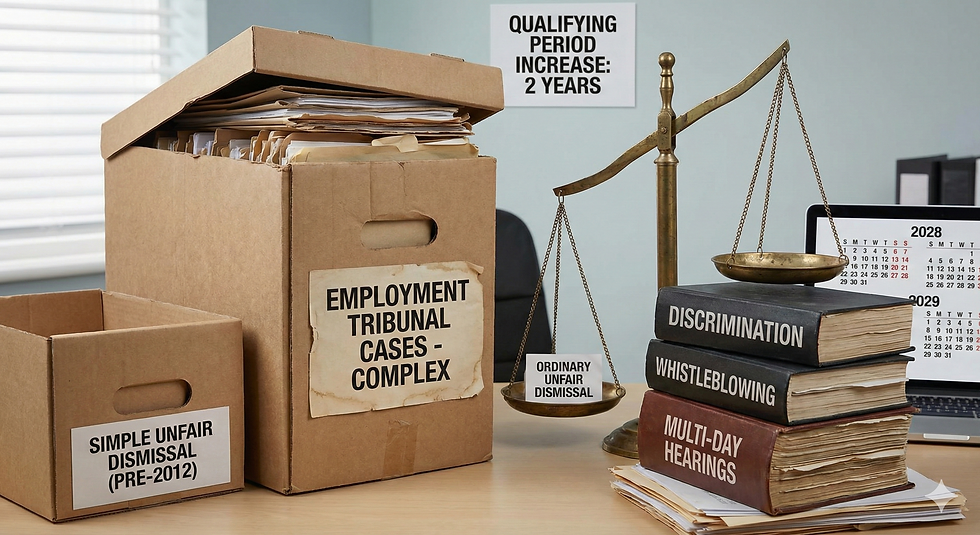
In 2012, the qualifying period for "ordinary" unfair dismissal was increased from one year to two. The logic seemed simple: by making it harder to sue, the number of Employment Tribunal claims would drop.
Instead, it created a "Day One" loophole that has spent the last decade clogging the system with complex, multi-day hearings. Here is why raising the qualifying period was one of the most counterproductive moves in the history of UK employment law.
1. The Pivot to "Day One" Rights
When a worker is treated unfairly but hasn't reached the 2-year mark, they don't simply walk away. Instead, they (and their advisors) look for the rights they do have from the first day of their job.
To get a hearing, claimants were forced to frame their disputes as Discrimination or Whistleblowing. Because these claims have no qualifying period, they became the only "door" left open for justice.
2. From Simple to Complex
This pivot transformed the nature of the Tribunal's workload:
Ordinary Unfair Dismissal: Usually a relatively simple 1-day hearing. The Judge asks: “Was the process fair and the decision reasonable?”
Discrimination/Whistleblowing: These are highly complex "Day One" rights that require deep dives into witness intent, internal emails, and comparative data. These cases rarely take one day; they often take three, five, or even ten days.
By trying to stop simple cases, the 2-year rule inadvertently flooded the system with the most time-consuming cases possible.
3. The Math of the Backlog
The result is the crisis we see today. With Tribunals forced to schedule 5-day hearings instead of 1-day ones, the calendar filled up fast. In regions like London South ET, we are now seeing hearings listed for 2028 and 2029.
When a system is this backed up, nobody wins. Employers face years of "litigation risk" and legal fees, and employees are left in limbo, unable to move on with their lives.
4. Pragmatism Over Compensation
What many policymakers fail to understand is that most claimants aren't looking for a "lottery win" payout. They want to be heard. They want an acknowledgement that a wrong was done.
If a simple unfair dismissal claim were available, many cases could be settled quickly and pragmatically. By forcing everything through the "discrimination lens," the stakes are raised, the positions become entrenched, and the opportunity for a quick, fair resolution vanishes.
A New Chapter in 2027
The good news is that the "experiment" is ending. With the qualifying period set to drop to 6 months on 1 January 2027, we may finally see a return to a more balanced system.
By allowing simpler claims to be heard on their own merits, we can hopefully move away from "kitchen sink" litigation and toward a tribunal system that is actually fit for the purpose of delivering timely justice.
![Aslam v Transport UK London Bus Ltd [2025] EAT 113: A Critical Reminder on Pleadings, Victimisation and Justice](https://static.wixstatic.com/media/5f7936_5ad3ad224a42476a8ceb38490b48a09a~mv2.png/v1/fill/w_980,h_547,al_c,q_90,usm_0.66_1.00_0.01,enc_avif,quality_auto/5f7936_5ad3ad224a42476a8ceb38490b48a09a~mv2.png)
